AI automation: definition, use cases, limits and implementation
AI automation is more than a chatbot and less autonomous than many demos suggest. This guide explains where AI belongs in business workflows, where fixed rules are better and what reliable operation requires.
Quick explanation
AI automation combines a controlled business process with selected AI steps. AI handles variable content; deterministic software checks rules, constrains actions, writes to systems and handles failures.
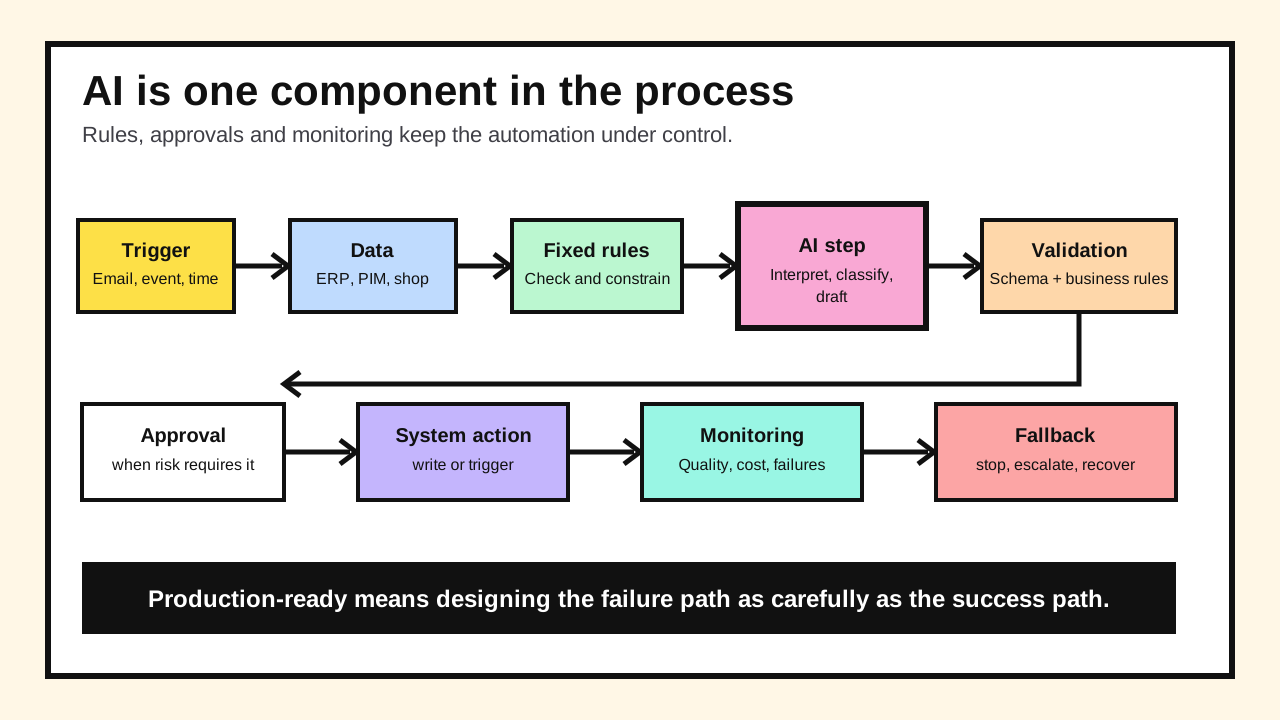
AI automation does not start with an agent
A supplier sends a product sheet as a PDF. An employee reads the dimensions, material and item number, assigns a category, enters the values in the PIM and checks the subsequent shop import. A language model can accelerate parts of this work. It should not invent a GTIN, overwrite prices without checks or publish an incomplete product.
This is where the term AI automation becomes vague. Some providers use it for an ordinary workflow with one model call. Others describe autonomous agents even though a person confirms every step. The implementation depends less on the label than on the allocation of responsibility: what does the AI interpret, which rules remain fixed, which action may the system perform, and what happens when an input is missing or a result is wrong?
A working definition for business
AI automation is a controlled business process in which AI performs selected variable tasks, such as interpreting free text, extracting data, classifying content or producing a draft. Orchestration, permissions, business rules, validation, approvals and failure handling remain part of the overall system.
What does AI automation mean?
Conventional automation executes predefined steps. When an order is paid, it sets a defined status. When a required field is missing, the import stops. Under the same conditions, the same input produces the same result. This predictability is useful for prices, tax, permissions, thresholds and accounting entries.
AI becomes useful when inputs vary or a classification cannot be described fully with rules. A model might recognise that “outer material: 100% virgin wool” in a supplier PDF belongs in the `material` attribute. It can classify a service email as a delivery problem or produce a reasoned shortlist of suitable products. Its output remains a model-based inference, not a hard-coded fact.
The EU AI Act defines an AI system as a machine-based system that operates with varying levels of autonomy and infers from its inputs how to generate outputs such as predictions, content, recommendations or decisions. Recital 12 distinguishes these systems from simpler software based solely on human-defined rules that execute operations automatically.[1]
That legal definition does not prescribe a good commerce workflow. The European Commission also says in its non-binding guidance that the definition should not be applied mechanically; each system needs assessment based on its actual characteristics.[2]
Four levels that are often confused
Level | What the system does | E-commerce example | Typical risk |
|---|---|---|---|
Digitisation | Information becomes digitally available. | A paper product sheet is stored as a PDF. | The manual work remains; only the medium changes. |
Deterministic automation | Fixed rules transfer, check or change data. | A valid paid order creates an ERP order according to fixed rules. | An unprogrammed exception stops or follows the wrong path. |
AI-assisted automation | A model handles variable interpretation or generation. | Attributes are extracted from different supplier PDFs and then validated. | The model output sounds plausible but can be factually wrong. |
AI agent | The system selects tools and next steps within a goal and permission boundary. | A service agent reads an order, checks rules and prepares an allowed action. | Broad permissions increase the impact of a bad decision. |
An agent is not a prerequisite for AI automation. Many production processes need only one or two tightly bounded AI steps inside an otherwise deterministic workflow. That design is often easier to test, cheaper to operate and simpler to secure.
The comparison of AI agents, copilots, chatbots, workflows and RPA separates interaction, path control and execution method, making it easier to identify the component a process actually needs.
Where AI adds value inside a process
The OECD describes an AI system in simplified terms as inputs, operational logic and outputs such as recommendations, predictions or decisions. People or machines can then act on the outputs.[3]
This decomposition is useful for business workflows because it moves the discussion away from model names and towards the job. An AI step is a credible choice when a recurring process receives variable content, has a testable objective and can reject or contain an incorrect result before it causes disproportionate harm.
- Interpret and structure free text, emails, PDFs, spreadsheets or images.
- Classify enquiries, documents, products or failures into an existing taxonomy.
- Extract fields and relationships from sources with inconsistent layouts.
- Draft product content, replies or summaries from approved sources.
- Recommend suitable products or the next handling step with a reason.
- Flag deviations and unusual cases for review.
AI is not a replacement for existing APIs, unambiguous database queries or stable business rules. Current stock belongs in the ERP or shop. VAT is calculated. Return eligibility is checked against dates and contract rules. A model can identify the intent of a customer message, but it should not guess a binding deadline.
Five useful e-commerce examples
Turning supplier files into product data
AI recognises tables, field labels and descriptive information across differing documents. Deterministic code checks data types, allowed units, GTIN check digits, required fields and available categories. Uncertain mappings enter an approval queue; only reviewed data reaches the PIM.
Preparing or handling service enquiries
A model classifies the request and extracts an order number, product and intent. The workflow retrieves the real order status and checks identity and allowed actions. It may draft a reply, while address changes, refunds or cancellations follow fixed rules and require approval when the risk calls for it.
Advising customers beyond keyword search
A product advisor translates a need such as “a light hiking shoe for wide feet and wet ground” into testable criteria. Search and filters use catalogue attributes, stock and prices. The language model asks clarifying questions and explains recommendations, but it must not fill in missing product properties.
Capturing orders from emails and PDFs
In B2B commerce, AI can read line items, quantities, units and delivery instructions from free-form purchase orders. The customer account, contract products, prices, credit limit and availability come from systems of record. Ambiguous items or unusual terms go to a person instead of being accepted silently.
Prioritising feed and listing errors
A model can group messages from different marketplaces, explain likely causes and propose a correction. The actual change is checked against the channel specification, internal data source and publishing rules. AI assists interpretation while the PIM or shop retains data authority.
The vertical guide to AI automation in e-commerce maps these and further processes across the commerce value chain, from product data and advice to service, orders and back-office work.
Production AI automation is more than a prompt
A demo often starts with an input and ends with a model response. A production system needs several layers on either side. The precise architecture depends on the process, but the following sequence covers the main responsibilities.
- Define the trigger: event, schedule, file, message or manual start.
- Retrieve context: read only the necessary data from the shop, ERP, PIM, CRM or knowledge sources.
- Apply deterministic pre-checks: required fields, permissions, thresholds and known exclusions.
- Bound the AI task: classify, extract, summarise, draft or make a limited selection.
- Validate the output: check schema, data types, references and business rules.
- Approve according to risk: continue safe standard cases and present uncertain or consequential cases.
- Perform the action: write through a constrained system identity or trigger a downstream process.
- Observe operation: record output quality, human corrections, cost, latency, failures and retries.
Failure handling belongs in the architecture
The failure path is not a later enhancement. Before the pilot, decide whether the workflow stops, retries, alerts a person or enters a manual queue. Otherwise the system automates only the happy path and returns the hardest cases to the team without useful context.
The NIST AI Risk Management Framework does not mandate a technical stack. It does call for documentation of business context, tasks, knowledge limits, human oversight and expected error costs. Systems should be tested before deployment and regularly in operation, and viable non-AI alternatives should remain part of the decision.[4]
Which processes are suitable for AI automation?
A suitable process is neither complete chaos nor something already solved with three simple rules. It has a recurring objective, enough digital examples and an accountable business owner. Variable inputs create effort today, but allowed outcomes and the impact of errors can still be described.
Question | Favourable signal | Warning signal |
|---|---|---|
Volume | The case occurs regularly and consumes measurable time. | A rare exception is selected because it is highly visible. |
Variation | Inputs differ but follow recurring patterns. | Every case requires a new negotiation or strategic judgement. |
Data | Digital sources, examples and a system of record exist. | Conflicting spreadsheets have no owner or freshness rules. |
Testability | Rules or reference data can distinguish correct from incorrect. | Quality depends only on the personal impression of one reviewer. |
Error impact | Errors are detectable, reversible or contained by approval. | A wrong action creates immediate serious financial or legal harm. |
Integration | Required systems provide dependable read and write paths. | The pilot ignores missing permissions, APIs or ownership. |
A useful starting point is a tightly scoped subprocess. Instead of “automate customer service”, choose “answer German-language delivery-status requests with an unambiguously verified order number”. That boundary produces test cases, permissions, metrics and a realistic fallback.
What should not be automated—or not automated fully
Autonomy should follow the impact of an error, not the fluency of a model response. A system can write persuasively and still select the wrong product variant, contract clause or root cause.
- High-impact legal, financial or safety decisions without effective control.
- Processes whose rules, owner and desired outcome remain disputed internally.
- Write access with broad administrator privileges when a narrow service identity is possible.
- Inferring facts, prices, stock or product properties from a model when a system of record exists.
- Automatic publishing without source grounding, validation or a withdrawal path.
- Treating full autonomy as the goal when assistance or partial automation has a better business case.
A human approval step is not sufficient by itself. The NIST profile for generative AI discusses automation bias: people may defer excessively to model outputs, particularly when they appear consistent and professional. An approval interface should therefore expose sources, uncertainty and the values that matter for the decision—not merely a green confirmation button.[5]
From idea to operated automation
1. Capture the current process and its exceptions
Document the input, handling steps, systems, roles, volume, waiting time, rework and known exceptional cases. Only then can a team tell whether AI closes a genuine gap or merely makes a poor process run faster.
2. Keep the first AI responsibility deliberately small
The first version should solve one concrete task and state what it will not do. For example: propose attributes from data sheets but do not publish products. A narrow scope reduces development effort and makes errors measurable.
3. Test with representative cases
A test set needs ordinary cases, difficult formats, missing values, contradictions and examples the system must reject. A pilot proves little if it processes only the success cases selected during development.
4. Separate actions and approvals by risk
Reading, producing a draft, preparing a record, writing and performing a financially consequential action are different permissions. They should be technically separate and granted per use case.
5. Measure operational value and operating load together
Saved handling time is not enough. Track acceptance rate, correction effort, critical errors, escalations, throughput, latency and cost per case. If employees re-check every output from scratch or hunt for subtle errors, the implementation has shifted work rather than removed it.
What good AI automation looks like
The best automation is not the one with the most autonomous agent. It reaches a defined process outcome within agreed quality, cost and risk boundaries. The relevant measures depend on the use case.
- Domain accuracy or the share of fully correct records.
- Share of suggestions accepted without edits.
- Human handling and escalation rates.
- Time from arrival to completed process.
- Critical errors, incorrect actions and safely contained cases.
- Model, infrastructure and operating cost per processed case.
- Stability after a model, prompt, data-source or target-system change.
Before launch, define which result is good enough and which signal limits or disables the workflow. Without that boundary, “usually works” remains an observation from a demo rather than an operating agreement.
Frequently asked questions about AI automation
Answers about the definition, conventional automation, agents, suitable processes and full autonomy.
What is AI automation in simple terms?
AI automation is a business process in which AI performs bounded tasks such as interpretation, extraction, classification or drafting. Deterministic software controls data access, rules, validation, actions, approvals and failure handling.
How is it different from conventional automation?
Conventional automation follows fully specified rules and produces the same output under the same conditions. AI-assisted automation uses models for variable inputs or inferences, so its output needs validation and controls proportionate to the risk.
Does every AI automation need an AI agent?
No. Many production systems are fixed workflows with one or two AI steps. An agent becomes useful when the system needs to select among several tools or next steps within a clear objective and permission boundary.
Which processes are particularly suitable?
Good candidates are recurring processes with variable digital inputs, a testable result, available reference data and containable error impact. Common examples include document and product-data processing, service classification, product advice and preparatory back-office work.
Can AI take over a process completely?
Full autonomy is rarely the most economical objective. Partial automation with fixed rules, constrained write access and human approval often provides a better combination of speed, quality and controllable risk.
Automate the right process, not the loudest AI use case.
The potential analysis examines one concrete e-commerce process: where an ordinary API or fixed workflow is sufficient, where AI adds value, which exceptions need a fallback and what a sensible first pilot would include.
Sources

Written by
Nils
Nils Abegg is a developer with more than 15 years of experience, including around ten years in e-commerce. Since 2023, he has focused on agentic AI and enjoys building practical AI solutions for small and medium-sized businesses.