AI automation in e-commerce: processes, use cases and architecture
This guide maps the main e-commerce processes, separates useful AI steps from conventional automation and explains the architecture across shop, ERP, PIM, CRM and human control.
Quick explanation
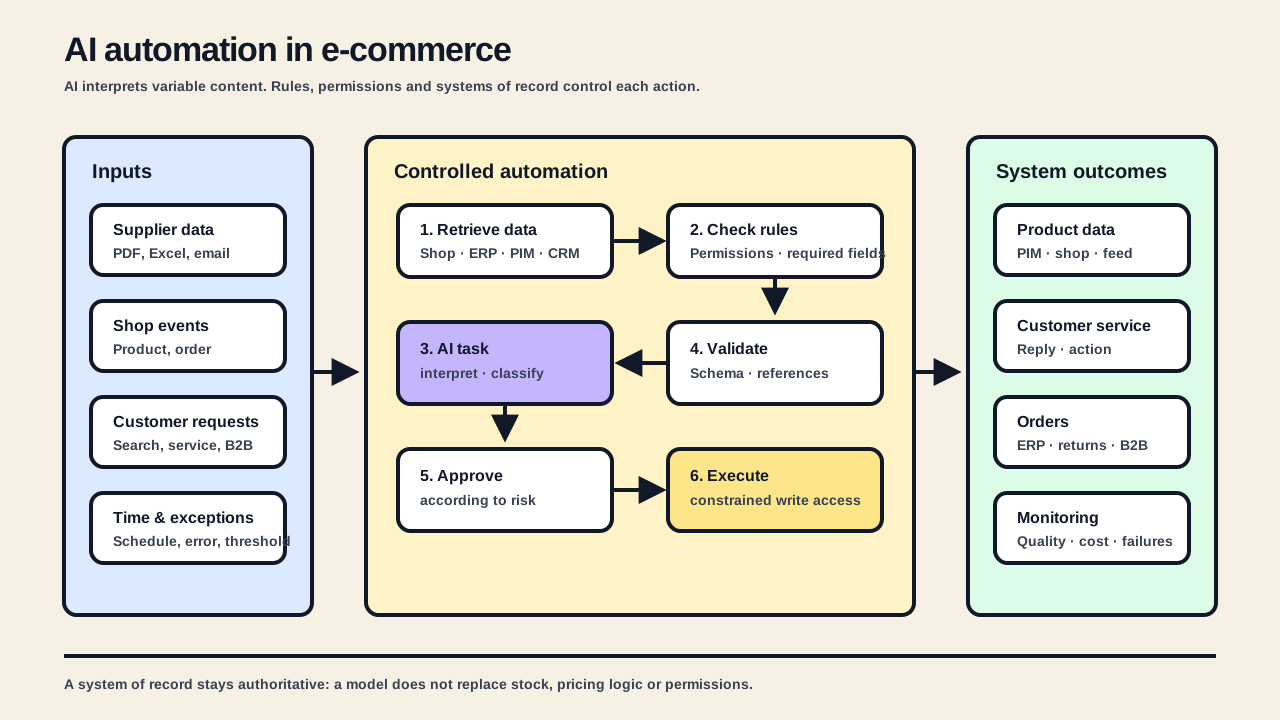
In e-commerce, AI is most useful for variable content: supplier files, product questions, service emails and exceptions. Prices, stock, permissions and transactions stay tied to fixed rules and systems of record.
The bottleneck usually sits between systems
A merchant can have a capable shop, a working ERP and a well-maintained PIM yet still copy product files, resolve delivery problems by email and trace marketplace errors across several interfaces every day. The work accumulates at the handovers: data arrives late, labels do not match, an API is missing or an exception needs context that fixed rules cannot fully describe.
AI automation is useful at these points because models can process inconsistent documents, free text and ambiguous requests. A model alone does not complete the process. It does not hold the binding stock figure or customer-specific pricing logic, should not approve every return and must not add a product property that exists in no approved source.
The general AI automation pillar page covers definitions and levels of autonomy. This guide asks the vertical question: which commerce processes fit, how do they interact with existing systems, and what architecture does production require?
The division of responsibility matters more than the model name
Useful e-commerce automation combines three kinds of work: deterministic software for unambiguous rules, AI for variable interpretation, and people for exceptions or decisions with significant consequences.
A process map for AI automation in e-commerce
The subject is often reduced to product copy, chatbots and personalised advertising. Operationally, it is much broader. Bitkom’s 2026 guide to AI trends in e-commerce covers advice, marketing, customer behaviour, assortment planning, B2B and agentic commerce, among other areas. For implementation, a map of actual operating responsibilities is more useful than a list of tools.[1]
Process area | Useful AI contribution | Deterministic control |
|---|---|---|
Product data and catalogue | Interpret documents, extract attributes, classify, translate | IDs, units, required fields, categories, approval and publication |
Search and product advice | Understand needs, ask questions, explain a shortlist | Filters, compatibility, price, stock and eligible products |
Customer service | Identify intent, retrieve knowledge, draft a reply | Identity, order data, deadlines, action rights and escalation |
Orders and returns | Interpret free text and documents, classify exceptions | Terms, payments, status changes, refunds and accounting |
B2B commerce | Read email orders, RFQs and technical requirements | Account, contract product, price, credit limit and approval |
Marketplaces and feeds | Group errors, map taxonomies, propose corrections | Channel specification, source, price, stock and publishing rules |
Marketing and CRM | Interpret segments, draft variants, analyse feedback | Consent, triggers, frequency, budget and brand approval |
Merchandising and back office | Explain anomalies, condense reports, generate proposals | Metric definition, forecast model, price boundary and financial approval |
Not every area needs generative AI. Demand forecasts, fraud scores and recommendations may rely on statistical models. Tax calculations, inventory postings and pricing rules belong in ordinary software in most cases. An LLM earns its place when language, documents or hard-to-formalise classification block an otherwise valid process.
Product and catalogue operations often provide the strongest structural leverage
Product data touches purchasing, PIM, shop, search, marketplaces, customer service and increasingly external shopping agents. An error is therefore rarely local. An incorrectly mapped material can damage filters, advice, feeds and the product page at the same time.
Onboarding supplier data
A production pipeline classifies incoming files, identifies the supplier, extracts values and maps them to the internal model. Deterministic rules then check data types, units, allowed values, GTIN check digits and required fields. Uncertain mappings enter an approval queue with their source and proposed value instead of going straight to the shop.
Classifying and enriching products
Models can assign products to an existing taxonomy, propose missing descriptive attributes or create content from approved data. The taxonomy, allowed properties and field ownership need definition first. Otherwise, AI merely automates contradictory data maintenance.
Distributing data to channels
Google’s product data specification requires consistent information about price, availability, identifiers and variants, among other attributes. Price and availability should match the landing page, structured data and checkout. Better prose does not create that consistency; authoritative data sources and synchronised write paths do.[2]
Google also recommends placing Product markup in the initial HTML and warns that dynamically generated markup can be less reliable for fast-changing details such as price and availability. This illustrates the boundary: AI may prepare content, but current offer data needs a dependable shop or ERP process.[3]
Search, advice and service need real commerce data
Product advice
An AI product advisor translates a need into catalogue criteria. It can ask follow-up questions, explain alternatives and describe differences. Its selection and answer must use available products, maintained attributes, current prices and stock. Without that connection, advice turns into a fluent product invention.
Semantic search
Semantic search helps with language that does not match catalogue wording exactly. In production it is usually combined with keyword search, filters and business rules. A vector can find related meaning; it cannot repair missing size data, incorrect variant relationships or stale inventory.
Customer service with action rights
A service workflow can classify a request, extract an order number and intent, retrieve the real status and draft a reply. Once it changes an address, initiates a return or prepares a refund, identity checks, roles, thresholds, logging and a clear failure path matter more than the writing style.
Transparency obligations under the EU AI Act are particularly relevant for systems that interact directly with people. The European Commission states that Article 50 applies from 2 August 2026 and that people generally need to be informed when they are interacting directly with an AI system.[4]
Orders, returns and B2B processes are valuable — and consequential
Handling order exceptions
Address errors, backorders, unusual payment data and unresolved mappings create manual queues. AI can group messages, interpret free text and propose a next handling step. Whether an order is stopped, changed or released remains tied to business rules and roles.
Preparing returns and complaints
An automation can capture the reason, product, deadline and available evidence. It may request missing information or prepare a standard case. Goodwill, warranty, refund amount and abuse checks cannot come from a plausible model response. Those decisions need rules, traceable data and approval where consequences demand it.
B2B orders from emails and PDFs
In B2B commerce, line items, quantities and delivery instructions often arrive in emails, PDFs or spreadsheets. AI can read that structure. The ERP must then confirm the account, contract product, customer price, unit, availability and credit limit. Ambiguous lines belong in a clarification loop, not in an automatically booked order.
Marketplace and feed failures
Messages from different channels can be grouped and prioritised. A model may explain a cause or propose a mapping. The correction still needs validation against the current channel specification and source of record. Otherwise, the workflow fixes the feed while the PIM reintroduces the same error on the next export.
The architecture connects event, data, decision and action
Production e-commerce automation is not a chat window beside the shop. It reacts to an event, reads constrained data, applies rules and a defined AI step, validates the result and writes back through a controlled identity.
- Trigger: product change, new file, customer request, order event, schedule or manual start.
- Context: retrieve only necessary data from shop, ERP, PIM, CRM, helpdesk or document storage.
- Pre-check: apply permissions, required fields, exclusions and thresholds deterministically.
- AI task: execute one narrow job such as extraction, classification, summarisation or drafting.
- Validation: check structure, references, allowed values and domain rules.
- Approval: let uncertainty and potential impact determine whether a person takes over.
- Action: write, publish or start a downstream process with minimal permissions.
- Operations: record quality, corrections, escalations, latency, cost and failures.
A system of record stays authoritative
Shop, ERP, PIM and CRM remain systems of record. The automation may interpret and move data between them, but it must not silently redefine their responsibilities.
Commerce platforms exposing product data specifically to external agents show where distribution is heading. Shopware’s Agentic Commerce documentation describes a Product Feed Sales Channel as an entry point for external systems and AI agents. Even there, the quality of product, price and availability data remains the technical foundation.[5]
Which e-commerce automation should come first?
The most visible use case is not automatically the best pilot. A good starting point combines recurring volume with testable results and limited consequences of error. It has access to the involved systems and a domain owner who can judge correct and incorrect outcomes.
Criterion | Good first pilot | Poor first pilot |
|---|---|---|
Process boundary | One concrete input and a defined result | “Automate all customer service” |
Data access | Digital sources and dependable reference data | Knowledge is scattered across private inboxes |
Testability | Results can be checked against rules or records | Quality is an undocumented personal preference |
Error impact | An error stops, becomes visible or is reversible | A wrong action immediately triggers payment or publication |
Integration | Read and write paths are known and constrainable | The pilot ignores missing APIs and permissions |
Learning value | The pilot tests data, exception handling and operations | An isolated demo tests only a prompt |
The German-language AI readiness check helps assess the organisational and technical starting point. Selecting a specific process also requires documented volume, handling time, exceptions, error cost and available integrations.
Measure the process, not the number of generated answers
A product-data workflow may depend on the share of completely correct attribute sets. Service needs factual resolution rate, escalations and wrongly executed actions. For B2B orders, line-level capture, clarification rate and cycle time matter more than a general “AI score”.
- Share of fully correct results, not merely valid output formats.
- Acceptance without edits and the actual human correction effort.
- Automation, approval and escalation rates by case type.
- Cycle time from intake to completed system action.
- Critical failures, safely contained cases and required recovery steps.
- Model, infrastructure and operating cost per processed case.
- Stability after changes to model, prompt, catalogue or target system.
The NIST AI Risk Management Framework calls for testing under conditions similar to deployment and monitoring system components in production. It also lists feedback, override, incident response, recovery and change management as parts of post-deployment planning. In e-commerce, a model-cost dashboard is therefore insufficient; domain errors and human corrections need to be visible as well.[6]
A realistic path from process discovery to operation
1. Document the process and system boundaries
Record the input, outcome, systems, roles, volume, waiting time, exceptions and manual rework. This reveals whether the problem truly needs interpretation or can be solved with a missing API, a clean rule or better master-data ownership.
2. Define sources of record and permissions
Every field and action needs a source and owner. Reading, proposing, preparing, writing and financially consequential actions are separate permissions. A service agent does not need blanket administrator access to the shop.
3. Bound the AI step and fallback
The first AI step solves one job, not one department. Missing information, invalid values and low confidence enter a defined fallback. A case does not deserve continuation merely because the model produced syntactically valid JSON.
4. Test representative cases
The dataset includes normal cases, rare formats, contradictions, missing values and examples that should be rejected. Domain acceptance and technical load are tested separately. Allowed actions expand only after those results are understood.
5. Assign operational ownership before launch
Someone must evaluate metrics, approve changes, handle failures and disable the automation. Models, data sources and target systems change. Without an owner, a successful pilot becomes an unattended integration process.
Frequently asked questions about AI automation in e-commerce
Answers about suitable e-commerce processes, product data, agents, cost factors and implementation.
Which e-commerce processes are particularly suitable?
Strong candidates include product-data and document workflows, service classification, product advice, B2B order capture and analysis of feed or order exceptions. They need a testable outcome, dependable reference data and containable consequences of error.
Does an online shop need an AI agent?
No. Many production solutions are deterministic workflows with one or two AI steps. An agent becomes useful when the system needs to choose among several tools or next steps within explicit goals and permissions.
Which systems need integration?
The main systems are usually the shop, ERP or inventory system, PIM, CRM or helpdesk and sometimes a DAM or marketplace middleware. The number of connections matters less than keeping clear ownership for each type of data and action.
Why is product data so important?
Product data drives filters, search, advice, feeds, copy and increasingly access for external shopping agents. AI can structure unstructured sources, but it cannot reliably replace missing IDs, contradictory ownership or stale prices.
What does AI automation in e-commerce cost?
Cost depends on process scope, system access, data quality, testing, human approval, hosting and operational requirements. A defensible business case calculates cost per processed case and includes integration, maintenance and correction effort as well as model usage.
Start with the right process, not a tool.
The potential analysis examines one concrete commerce process, its data and system boundaries. The result is a defensible choice between conventional automation, a bounded AI step, an agent and human control.
Sources

Written by
Nils
Nils Abegg is a developer with more than 15 years of experience, including around ten years in e-commerce. Since 2023, he has focused on agentic AI and enjoys building practical AI solutions for small and medium-sized businesses.