DPP Requirements and Timelines by Sector: What Is Actually Known Today
Which DPP timeline statements are binding and which are only indicative? This guide separates legal act, transition period and actual product obligation.
Kurz erklärt
A year in the ESPR working plan is usually a target for adopting a legal act, not automatically the obligation date for every product. Batteries are the important exception with a fixed date.
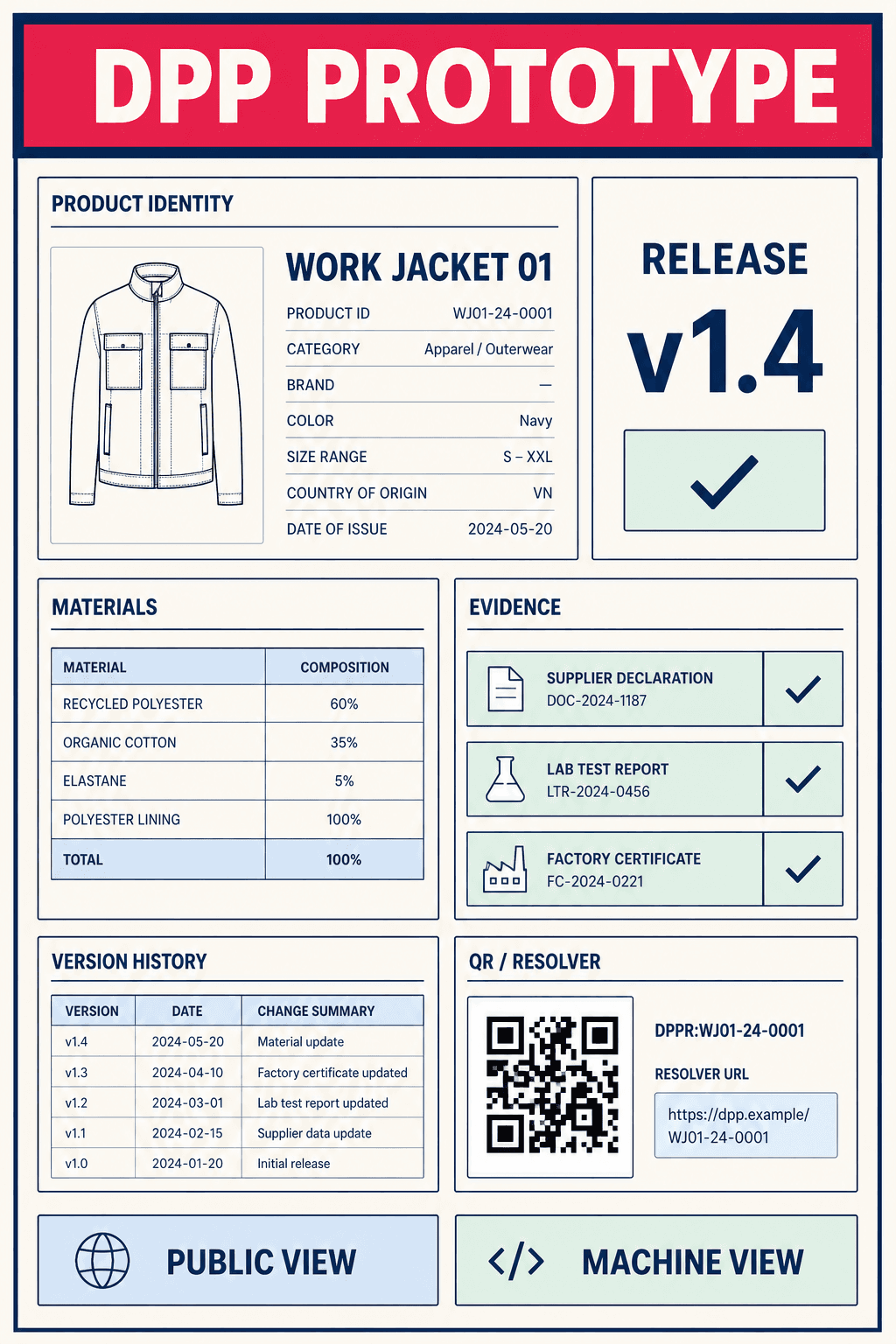
This page explores one part of the Digital Product Passport. For implementation, the DPP data model connects product identity, fields, evidence and access rights.
Three dates that must not be confused
Digital Product Passport rules emerge in layers. The ESPR Regulation creates the framework. The working plan prioritises product groups and, for many of them, gives only an indicative target for a delegated act. Only a product-specific act determines the precise scope, datasets, identifier, access rights and transition period.
This is not a technicality. Treating “textiles 2027” as a sales prohibition from 1 January is planning on a false assumption. The ESPR and Energy Labelling Working Plan 2025–2030 itself describes those dates as indicative adoption timelines. For many groups, a transition period follows afterwards.
Version note
Status of this page: 18 July 2026. The table does not predict fields in future legal acts. It shows the legal stage reached and the preparation that makes sense today without speculation.
From ESPR to an applicable obligation
A DPP timeline must distinguish the framework rule, the sector-specific legal act and its application.
Framework applies
Working plan
Specific rule
Fixed date
What companies should assess for each product group
The European Commission publishes a current DPP timeline. Alongside the battery passport, it lists expected acts for iron and steel, textiles, aluminium, tyres, furniture and mattresses. This guide deliberately describes that as rulemaking status, not as a blanket end date for every product.The Commission DPP timeline is the primary source for this framing.
Sector | Reliable status on 18 July 2026 | Sensible preparation now |
|---|---|---|
Batteries | For relevant electric-vehicle, light-means-of-transport and industrial batteries, the battery passport applies from 18 February 2027. | Review data points, roles, supplier evidence, identifier and access for the actual scope. |
Iron and steel | The Commission timeline schedules a sector-specific act for late 2026. | Inventory product and batch structure plus material and origin evidence. |
Textiles, aluminium, tyres | The timeline schedules adoption of sector-specific acts for the second half of 2027. | Structure data sources, variants, supplier declarations and product identity. |
Furniture | The timeline schedules a sector-specific act for 2028. | Capture materials, components, repair and disassembly information systematically. |
Mattresses | The timeline schedules a sector-specific act for 2029. | Model bills of materials, material composition and take-back or circular processes. |
Construction products | The DPP follows the separate Construction Products Regulation path; design is sector-specific. | Bring together DoP/DoPC, technical data, environmental information and BIM-adjacent data sources. |
The broader question “Which products are generally affected?” is answered by the product-groups overview. This page complements it with the distinction that matters for a roadmap: known obligation versus expected rulemaking.
Three questions before every investment
- Which legal act or sector-specific rule applies to our actual product and our role?
- Which data can we already support with source, version and accountable person?
- Which architecture decision is reversible now, and which should stay open until the final legal act?
Answering these questions makes it possible to begin a data and process pilot without inventing data fields. The implementation roadmap describes that sequence. For representing and checking an example, the DPP example and template shows the necessary layers.
Recheck legal status before publication
This guide does not replace review of a legal act, a battery category or another sector-specific rule. For dates, the word “planned” matters: it must not be translated into “mandatory”.

Written by
Nils
Nils Abegg is a developer with more than 15 years of experience, including around ten years in e-commerce. Since 2023, he has focused on agentic AI and enjoys building practical AI solutions for small and medium-sized businesses.