ESPR Regulation: What Businesses Need to Know About Ecodesign and the DPP
The Ecodesign for Sustainable Products Regulation creates the legal framework for more durable, repairable and circular goods – and for the Digital Product Passport. The key is to distinguish the framework regulation, the working plan and the product-specific delegated act.
In brief
The ESPR is the European framework regulation for more sustainable products. It does not immediately impose a Digital Product Passport on every physical good. Delegated acts define the specific ecodesign requirements, DPP data and transition periods for each covered product group.
This page explores one part of the Digital Product Passport. For implementation, the DPP data model connects product identity, fields, evidence and access rights.
The ESPR – short for the Ecodesign for Sustainable Products Regulation – is Regulation (EU) 2024/1781. It has applied since July 2024 and replaces the former Ecodesign Directive. Its approach is much broader: instead of focusing mainly on energy-related products, it establishes a framework capable of covering almost all physical goods placed on the EU market. (Regulation (EU) 2024/1781, Article 1)
For businesses, it is equally important to understand what the ESPR is not. It is not a finished list of every future data field and it does not set one universal compliance date for all product groups. The regulation supplies the legal and technical architecture. Product-specific obligations emerge progressively through further legal acts.
The most important distinction
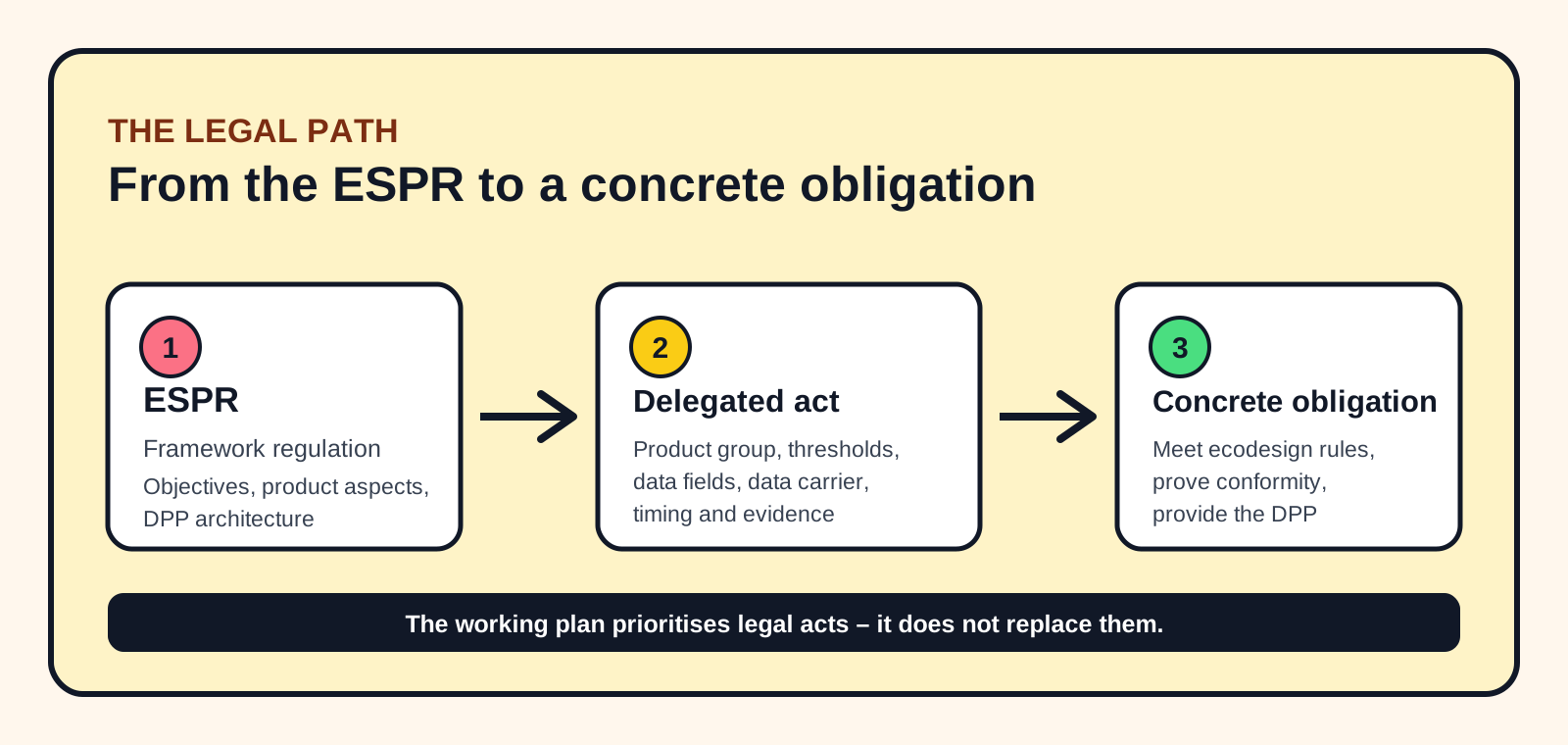
The entry into force of the ESPR does not mean that every product within its broad scope already needs a Digital Product Passport. Whether a DPP is required, what it must contain and when the obligation applies are normally determined by the delegated act for the relevant product group.
For the current status of priority products and an explanation of official planning years, see Digital Product Passport: Which Product Groups Are Affected?
What is the ESPR?
The ESPR is a directly applicable EU regulation and a framework measure. Its purpose is to improve the environmental sustainability of products throughout their life cycle, reduce their carbon and environmental footprints and safeguard the free movement of compliant products within the internal market. It also introduces the legal architecture for the Digital Product Passport, enables mandatory green public procurement criteria and establishes measures addressing the destruction of unsold consumer products.
In this context, “ecodesign” is not limited to a product’s appearance. It covers decisions that shape environmental performance: material selection, construction, energy and water use, software support, repairability, spare parts, disassembly, reuse, remanufacturing and recycling. Sustainability therefore moves from optional communication into product development and conformity assessment.
The ESPR explains the purpose and the core system. The delegated act answers what, who, how and when for a particular product group.
Which products are within the general scope?
Article 1 generally covers all physical goods placed on the market or put into service. Components and intermediate products are expressly included. The reach may therefore extend beyond a finished item sold to a customer: a material, component or semi-finished product can be regulated in its own right and can also supply data to the passport of a downstream product.
The general scope excludes in particular:
- food and feed,
- medicinal products for human or veterinary use,
- living plants, animals and microorganisms,
- products of human origin and certain plant and animal products directly related to future reproduction,
- vehicles for product aspects already governed by relevant sector-specific EU legislation.
Products outside the exclusions are not regulated simultaneously. The Commission prioritises groups by improvement potential, market size, environmental impact, resource use and waste before studies, consultation and law-making begin.
Some sectors have separate DPP legislation rather than an ESPR delegated act. The Digital Product Passport overview explains the concept across legal regimes.
How the ESPR becomes a concrete obligation
The system follows three legal levels. The ESPR supplies the empowerment, objectives, product aspects and core rules. The working plan identifies which measures the Commission intends to develop first. A delegated act turns that framework into binding rules for a defined product group.
Level | Function | What a business can infer |
|---|---|---|
ESPR | Permanent EU framework | Understand possible requirements, DPP architecture and legal roles |
Working plan | Prioritises Commission work | Monitor relevant product groups and plan resources |
Delegated act | Binding specification | Implement scope, data, evidence, DPP level and timing |
This distinction prevents two common mistakes. First, inclusion in the working plan is not an immediately applicable product obligation. Second, an indicative year for adopting an act is not necessarily the date on which products must comply. Publication, entry into force and the transition period in the final act determine the legal timetable.
The relationship between the ESPR and the Digital Product Passport
The Digital Product Passport is one instrument within the ESPR, not its only purpose. Performance requirements can change the physical or functional characteristics of a product. Information requirements make sustainability, use or conformity data available. The DPP is the central digital infrastructure through which some of that information can be shared in a structured form with the appropriate audience.
Article 9 is decisive: where the applicable delegated act requires a DPP, the product may be placed on the market or put into service only if the passport is available. Its data must be accurate, complete and up to date. The delegated act must determine the data, data carrier, placement and whether the passport operates at model, batch or item level. (Regulation (EU) 2024/1781, Article 9)
Access is also product-specific. Customers, manufacturers, importers, distributors, dealers, repairers, remanufacturers, recyclers, market-surveillance authorities and customs do not necessarily need the same information. A DPP is therefore not simply one public web page; it can combine public information with restricted data views based on legally defined access rights.
The ESPR establishes core technical principles:
- a persistent unique product identifier linked through a data carrier,
- open standards, interoperable formats and, where needed, machine-readable, structured and searchable data,
- no storage of customer personal data without explicit consent,
- free and easy access for relevant actors according to their access rights,
- availability for the required period and a backup copy held by an independent DPP service provider.
For the practical route from the ESPR data carrier to the passport, see the guide to DPP QR codes, GS1 Digital Link and resolvers.
Which ecodesign requirements are possible?
Under Article 5, delegated acts may address a product aspect where it is relevant to the group concerned. The list includes durability, reliability, reusability, upgradability, repairability and maintenance, as well as energy, water and resource use and efficiency. (Regulation (EU) 2024/1781, Article 5 and Annex I)
Other possible subjects include substances of concern, recycled content, remanufacturing, recyclability, recovery of materials, carbon and environmental footprints and expected waste generation. Requirements may also address premature obsolescence, such as unnecessarily weak components, difficult disassembly, unavailable spare parts or missing software updates.
Change performance and make information available
A delegated act may combine both instruments. The exact mix depends on the product and its environmental impacts.
Performance requirements
Measurable minimum or maximum values, design rules or functional properties – for example durability, repairability or energy efficiency.
Information requirements
Information for customers, authorities and value-chain actors, provided on the product, in documents, on a label or through the Digital Product Passport.
Not every parameter will apply to every product. The Commission must assess relevance, proportionality, technical feasibility and impacts. Concrete DPP data fields therefore cannot be derived reliably from the general ESPR list alone.
Why delegated acts are decisive
Article 4 empowers the Commission to supplement the ESPR through delegated acts. An act can apply to a defined product group or establish horizontal requirements across several groups. It defines the precise material scope and the applicable performance and information requirements.
For a DPP programme, that act is the operational specification. It can determine whether the passport is tied to a model, batch or individual item; which identifiers are required; who may read or update data; how long the passport remains available; which conformity-assessment procedure applies; and when compliance becomes mandatory.
Separate drafts from applicable law
A delegated act is not optional guidance. Once adopted, it forms part of binding EU law. Drafts, preparatory studies and consultations are valuable planning inputs, but they do not replace the final published text.
What the ESPR working plan establishes
Article 18 requires the Commission to publish and regularly update a working plan covering at least three years. It identifies priority product groups, horizontal measures and an indicative timetable for setting requirements. Prioritisation considers improvement potential, market volume, environmental impacts, energy and resource use and waste generation. (Regulation (EU) 2024/1781, Article 18)
The first combined ESPR and Energy Labelling Working Plan covers 2025 to 2030. It prioritises final and intermediate products, announces horizontal measures capable of reaching multiple groups and carries forward work on already regulated energy-related products. (ESPR and Energy Labelling Working Plan 2025–2030)
The plan is an early-warning signal, not a list of current DPP duties. Priority groups and official planning years are maintained on Which Product Groups Are Affected?.
Obligations for manufacturers, importers, distributors and dealers
Concrete duties apply to products covered by an applicable delegated act. The ESPR distributes responsibility across the supply and distribution chain. These roles are more than organisational labels: an operator that markets a product under its own name or trade mark, or modifies it in a way that affects conformity, may be treated as the manufacturer.
Role | Core responsibilities under the ESPR framework |
|---|---|
Manufacturer | Compliant design and manufacture, technical documentation, conformity assessment, declaration and marking, plus the DPP and backup where required. |
Importer | Before market placement, verify the manufacturer procedure, documents, marking and DPP; provide contact details and act on non-conformity. |
Distributor | Exercise due care and verify marking, documents, instructions and, where applicable, the Digital Product Passport. |
Dealer | Make required information and the DPP easily accessible to customers and potential customers, including in distance selling. |
Before placing a covered product on the market, a manufacturer must carry out the required conformity-assessment procedure, prepare technical documentation and generally issue an EU declaration of conformity. Serial production needs processes that maintain continuing conformity. Product changes and regulatory changes must therefore flow into documentation and DPP updates in a controlled way. (Regulation (EU) 2024/1781, Article 27)
Importers and distributors have their own verification and response duties. If there is reason to believe that a product is not compliant, it cannot simply continue into the market. Corrective action, withdrawal or recall and notification of the competent authorities may be necessary. The ESPR also includes cooperation and information rules for online marketplaces and fulfilment service providers.
DPP responsibility should be allocated contractually and technically: source data, validation, identifiers, publication, updates and error handling all need a named owner.
Market surveillance and conformity evidence
The DPP does not automatically replace conformity assessment. It can make evidence discoverable and support authority checks, but technical documentation, test methods, the EU declaration of conformity and CE or alternative marking remain governed by the ESPR and the delegated act. The applicable assessment modules depend on the nature and risk of the requirements.
Market surveillance works together with Regulation (EU) 2019/1020. Member States must include ESPR enforcement in their strategies, and checks may include document reviews, physical inspections and laboratory testing. Priorities can reflect the frequency and environmental impact of non-compliance, market volume or complaints. (Regulation (EU) 2024/1781, Articles 66–71)
Where an authority finds non-compliance, it can require proportionate corrective action. If the breach persists, market availability can be restricted or prohibited and products can be withdrawn or recalled. Formal defects also matter, including a missing declaration of conformity, incomplete technical documentation or incorrect manufacturer or importer information.
A defensible evidence chain therefore connects four levels:
- the binding requirement and its test or calculation method,
- underlying measurements, supplier evidence and approvals,
- the technical documentation and declaration of conformity,
- DPP data derived from those sources, with version, provenance, owner and update date.
Building only the visible passport page without proving the origin and quality of its data does not solve the central compliance problem.
Prepare for the ESPR in five steps
A company can make useful progress even before all product-specific details exist. The aim is not to guess unknown requirements, but to create data and accountability structures that allow new duties to be incorporated in a controlled way.
From scope analysis to a defensible pilot
These five steps separate regulatory monitoring from technical implementation and start with products and source data.
1. Define the product portfolio
Map the product portfolio, components and intermediate products to relevant EU legal routes. Document ESPR priorities separately from sector-specific DPP regimes.
2. Establish regulatory monitoring
Monitor the working plan, preparatory studies, consultations and published acts. Record the source, legal status and next review date for every conclusion.
3. Expose data gaps
Inventory ERP, PIM, PLM, supplier portals, test reports and spreadsheets. For each field, identify provenance, owner, quality and update frequency.
4. Set governance
Define accountability, approvals, change processes and supplier contracts. Involve legal, sustainability, product, procurement, quality and IT teams.
5. Run a technical pilot
Use a representative product family to test identifiers, data carriers, access rights, versioning and the evidence chain. Capture the result as a reusable pattern.
For the operational and technical foundation, continue with Digital Product Passport Explained.
Conclusion: Understand the framework, implement the delegated act
The ESPR changes product development and product data profoundly, but it does not do so through one universal DPP duty. Its lasting value is the common framework: sustainability-related performance and information requirements, interoperable DPP architecture, defined economic-operator duties and mechanisms for conformity and market surveillance.
ESPR Regulation FAQ
Answers about the relationship between the framework regulation, working plan, delegated acts and Digital Product Passport.
Is the ESPR a “DPP Regulation”?
The ESPR is the central framework regulation for ecodesign requirements for sustainable products and contains the general Digital Product Passport architecture. It is not the only legal basis for product passports. Some groups have sector-specific regimes, and under the ESPR a delegated act must still specify whether and how a DPP applies.
Has every product needed a Digital Product Passport since the ESPR entered into force?
No. The ESPR applies as a framework, but a concrete DPP obligation for a product group normally begins only when the applicable delegated act establishes it and its transition period has expired. Separate EU sector legislation can create additional passport duties.
Is the ESPR working plan already binding on businesses?
The working plan directs and prioritises the work of the European Commission. It is an important planning signal, but it does not contain the complete directly applicable product requirement. The later delegated act remains decisive for scope, requirements and application date.
What information will a Digital Product Passport contain?
There is no single answer for all products. The delegated act selects data within the ESPR framework and defines the passport level, data carrier, placement, access rights, responsibility for creation and updates and the availability period. Identity, material, environmental, repair, use, recycling and conformity information may all be relevant.
Is a QR code enough for ESPR compliance?
No. A QR code can serve as the data carrier, but it is only the access point. It does not replace accurate and current data, unique identifiers, technical documentation, conformity assessment, access controls, interoperability, long-term availability or the required backup copy.
When should a company start preparing?
Preparation is sensible as soon as products, components or important materials appear in a priority group or an already regulated sector. Portfolio analysis, regulatory monitoring, a data inventory, supplier requirements and a limited pilot can start early. The final requirements matrix should be based on the final applicable legal act.
Sources and currency
This article provides general information and does not replace legal advice. The versions published in the Official Journal of the European Union and the legal act applicable to the relevant product group are authoritative.
Turn ESPR preparation into a practical programme
Want to prepare your product portfolio, data sources and DPP architecture for emerging requirements? We structure scope, data gaps and a defensible pilot.

Written by
Nils
Nils Abegg is a developer with more than 15 years of experience, including around ten years in e-commerce. Since 2023, he has focused on agentic AI and enjoys building practical AI solutions for small and medium-sized businesses.