Implementing a Digital Product Passport: A Roadmap from Data Check to Operation
A robust DPP roadmap does not start with a QR code. It connects legal status, product data, ownership and technology in a controllable pilot.
Kurz erklärt
First clarify the affected product and provable data, then build a representative pilot and scale only afterwards.
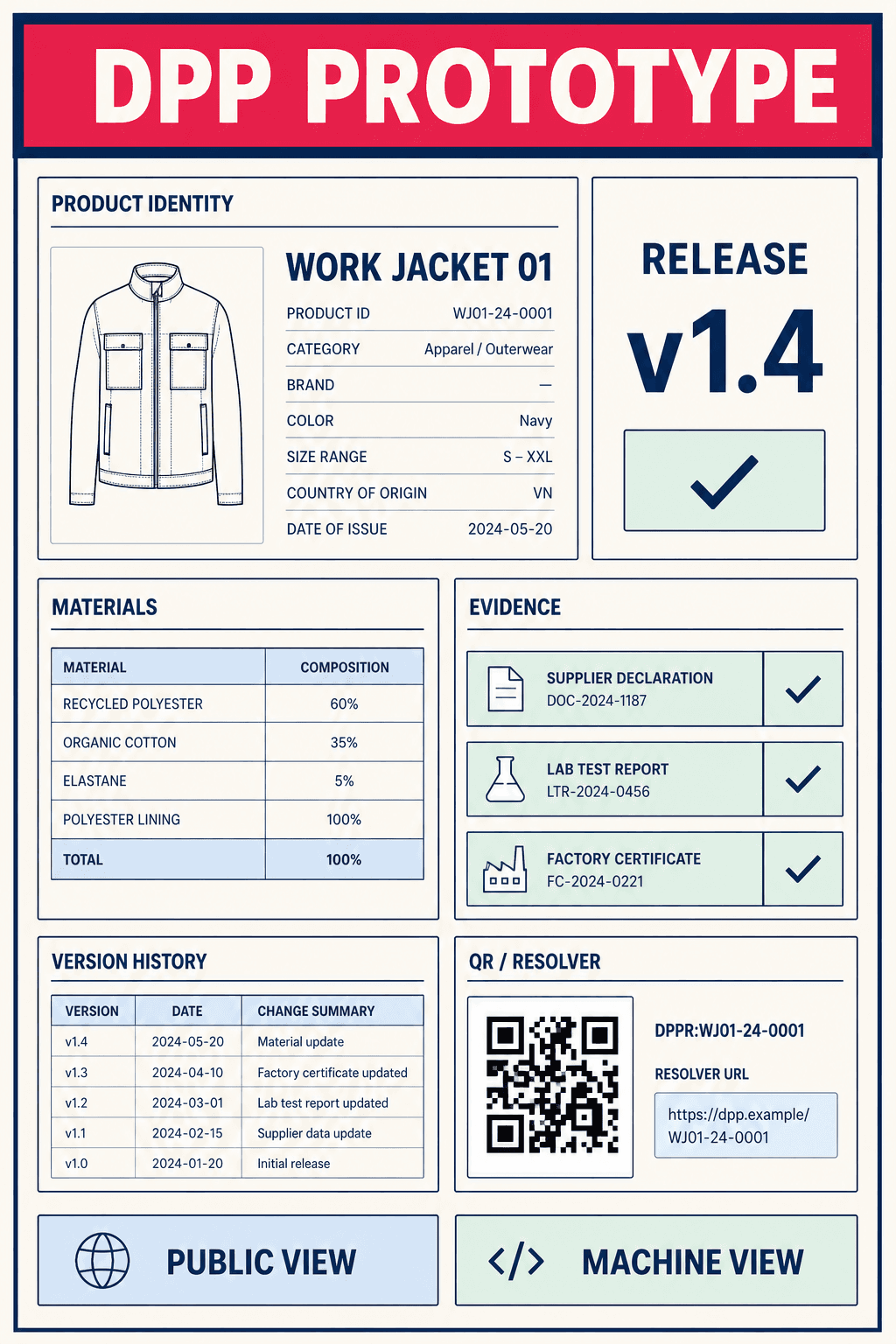
This page explores one part of the Digital Product Passport. For implementation, the DPP data model connects product identity, fields, evidence and access rights.
A roadmap is not a generic timetable
There is no credible fixed-week plan for a Digital Product Passport. Concrete obligations arise by product group. The European Commission describes the DPP as a progressively introduced system, so economic operators first need to establish which rule and which role actually apply to their products.The European Commission DPP overview is the starting point for that assessment.
The more practical question is: for one specific product, can we prove where every required claim comes from, who releases it, and how it will later be updated or withdrawn? That is what separates a clickable prototype from an operational product-data solution.
Pilot does not mean: only make it look good
A pilot can start with representative data. It must not label missing evidence, unclear ownership or unverified claims as complete. Open issues belong in a visible data-gap backlog.
From first decision to operation
Three connected phases
This is not a legally prescribed sequence. It does prevent a QR-code project from starting before its data foundation exists.
1. Decide
Define applicability, product granularity, required data, data sources and accountable roles.
2. Prove
Model a representative product, connect evidence, and test identifiers and access routes.
3. Scale
Extend supplier work, quality controls, integrations, changes and operations to additional products.
Phase 1: Establish applicability, target state and data gaps
Choose a representative pilot product, not a showroom product: one with a realistic supply chain, variants, documents and the difficulties that will recur during rollout. Review the role of manufacturer, importer or distributor and the product group. The EU places duties on economic operators that place covered products on the EU market.The Commission guidance for economic operators makes those roles explicit.
Workstream | Decision | Tangible output |
|---|---|---|
Scope | Which product, market and product granularity? | Approved pilot scope |
Data | Which claim needs which primary evidence? | Data-point and evidence register |
Governance | Who provides, checks and publishes? | RACI and release rule |
Technology | Where do data, identifier, version and access live? | Architecture sketch with open decisions |
The existing product groups and timelines helps with the legal classification; the detailed requirements and timeline by segment distinguishes established information from expected developments.
Phase 2: Build a passport model and test it in the real data flow
This is not a generic datasheet. It is a controlled product-data state. The model needs at least a persistent identifier, relevant data fields, references to evidence, a release, and a decision about who sees which view. A QR code, Data Matrix or other carrier then initiates access; it does not replace those layers.
The technical architecture does not need to replace every system. It needs to connect sources, validation, versioning and publication in a traceable way. Fraunhofer IPK identifies data-point analysis, data-availability assessment and a needs-based roadmap as central work; this is often more important than the public passport view.The Fraunhofer IPK implementation strategy describes that emphasis.
For a concrete field structure, the example and template page separates product identity, evidence, data sources and assumptions. That makes it clear in a pilot which gaps are business, technical or supplier-side.
Phase 3: Standardise and scale only after the pilot
A successful pilot produces more than a page to show. It produces reusable rules: data provenance, validation logic, minimum quality, releases, roles, change process, fallbacks for unavailable data and test cases. Those become templates for other product families and concrete requirements for PIM, ERP, PLM, supplier portals or a DPP platform.
The decision between an in-house solution, an extension of existing systems or a platform is therefore not about the price of a QR code. It is about reuse, changeability, supplier onboarding, rights, evidence and a clean exit path. The DPP software selection and cost guide turns this into testable selection questions.
What this roadmap deliberately does not promise
DPP details remain product-specific. Recheck data fields, identifiers, access rights and transition periods when each new rule arrives. This roadmap is an implementation structure, not legal advice or a prediction of future delegated acts.
The target architecture also needs an access layer. The guide to DPP QR codes and GS1 Digital Link shows how identity, resolution, hosting and roles fit together.

Written by
Nils
Nils Abegg is a developer with more than 15 years of experience, including around ten years in e-commerce. Since 2023, he has focused on agentic AI and enjoys building practical AI solutions for small and medium-sized businesses.