DPP Software, Providers and Costs: How to Evaluate a Solution
DPP software is not bought as a QR code. This decision guide separates platform, data work, integration, operation and actual total cost.
Kurz erklärt
A provider can supply infrastructure. Responsibility for correct product information, evidence and processes remains with the economic operator.
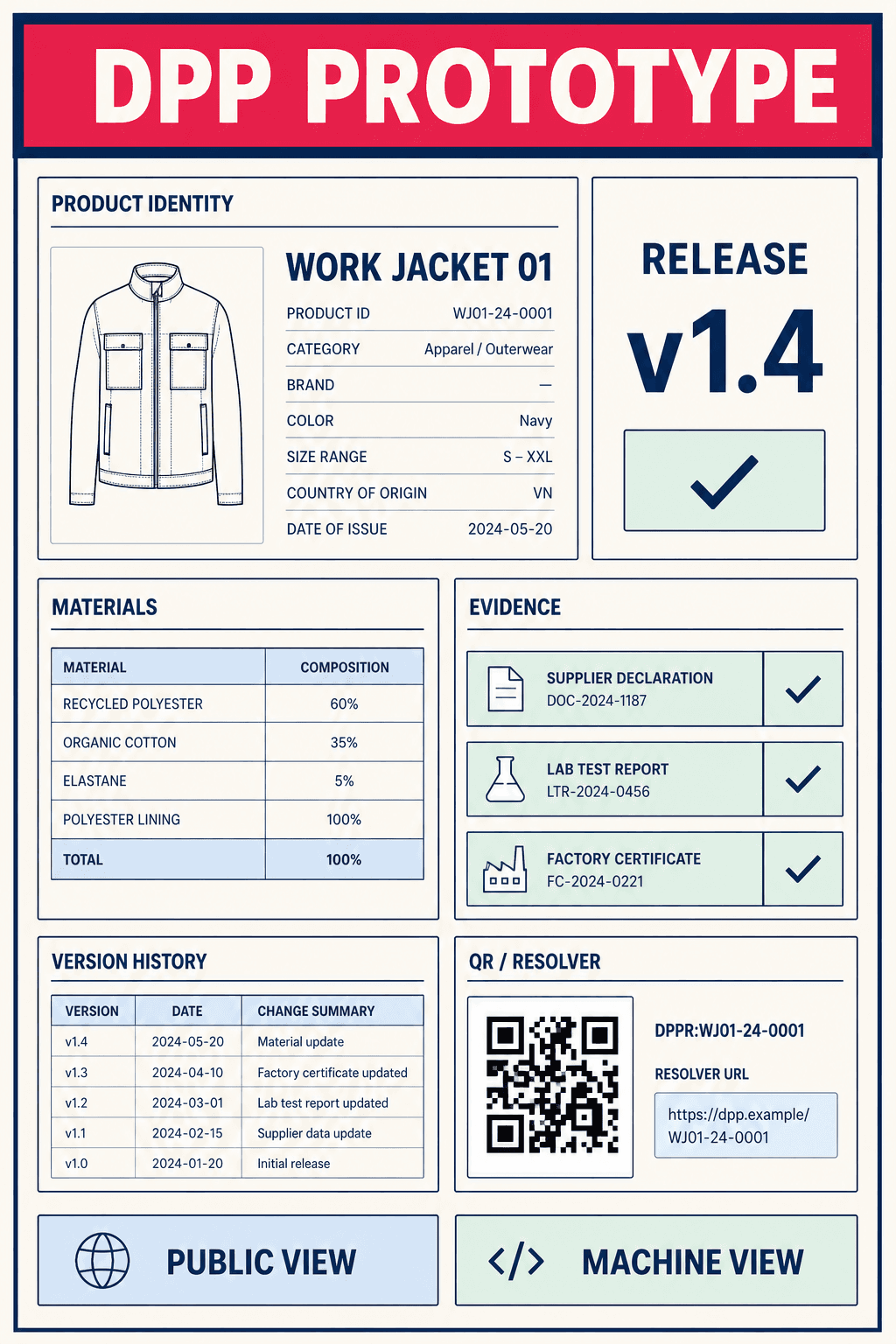
This page explores one part of the Digital Product Passport. For implementation, the DPP data model connects product identity, fields, evidence and access rights.
Comparing DPP vendors: five questions before the demo
Do identifiers, domains and resolution remain under our control?
Can field definitions, versions, evidence and access rules be exported completely?
What is charged per model, batch, item, scan, API call and storage year?
How are corrections, archiving, role changes and contract termination handled?
Which existing systems remain authoritative and which data is duplicated?
Build the vendor longlist only after defining your own DPP data model. This lets you compare vendors against a data contract rather than a prepared demo. The DPP consulting and implementation page explains support for architecture and selection.
What software does and does not take over
A DPP platform can connect data sources, manage templates, run checks, issue identifiers, publish passport views and log changes. It cannot decide whether a supplier statement is true or which legal duty applies to a product. The Commission assigns responsibility to economic operators; complete product information may be stored by the operator itself or by a DPP service provider.The European Commission DPP information describes this division.
Separate marketing language from testable criteria
“DPP-ready” is not a uniform protected product promise. For every solution, ask which product-specific legal acts, data models and registry or identifier functions it demonstrably supports today, and which are only on a roadmap.
The total cost rarely sits in the passport page
Do not compare licence prices alone. A small portfolio with a well-maintained PIM can have a different cost profile from a catalogue with many variants, suppliers, evidence documents and individual serial numbers. Providers publish very different pricing models; that does not establish a reliable market price. Procurement needs to know which cost category grows in its own scenario.
Cost block | What it includes | Procurement question |
|---|---|---|
Set-up | Data model, roles, brands, templates, identifiers and migration. | One-off, per legal entity or per product group? |
Data work | Inventory, clean-up, mapping, evidence and supplier follow-up. | Who performs it and how is quality checked? |
Integration | PIM, ERP, PLM, LCA tools, documents, shop, APIs and events. | Which interfaces are standard and which are project work? |
Usage | Licences, active passports, SKUs, users, brands, storage or requests. | Which volume driver matches our catalogue? |
Operation | Monitoring, changes, security updates, support, audit and training. | Which service remains in the contract over time? |
Exit | Export, evidence chains, URLs, data model and handover to a successor. | Can we export in a readable, structured form? |
The technically important question behind cost is data control. Fraunhofer describes DPP architectures as connections between existing data spaces and systems; a platform can be that layer, but it does not automatically have to become the business source for every piece of information.The Fraunhofer view on DPP architecture and the Asset Administration Shell explains that distinction.
A selection scorecard instead of a best-of list
A generic best-of list would be misleading: the right approach depends on product group, data maturity, number of variants, supplier network and desired independence. Evaluate every solution with the same testable questions and record answers, product demonstrations and contractual commitments separately.
- Can the solution distinguish model, batch and item level and resolve identifiers over time?
- How are data provenance, document version, validity, release and correction made visible?
- Which roles and access rights work for consumers, service, suppliers, auditors and authorities?
- How are PIM, ERP, PLM and supplier data integrated, and who operates error handling?
- Which data models, standards and sector requirements are proven in production, and at which release level?
- How do we export passport, evidence, identifiers and history if we switch provider or face insolvency?
Selection should follow a representative data pilot, not only a slide demo. The DPP implementation roadmap provides the sequence. A completed data model from the example and template page makes the demonstration testable.
Why there is no ranking here
This page does not recommend a provider or claim a complete market overview. Prices, features and legal support change quickly; turn them into written procurement questions, not permanent truths from an article.
Provider evaluation should cover identifier ownership, domains and resolution. The guide to DPP QR codes and GS1 Digital Link summarises requirements for that access layer.

Written by
Nils
Nils Abegg is a developer with more than 15 years of experience, including around ten years in e-commerce. Since 2023, he has focused on agentic AI and enjoys building practical AI solutions for small and medium-sized businesses.