DPP vs. EPD: How to distinguish the Digital Product Passport and Environmental Product Declaration
DPPs and EPDs are often treated as competing concepts. In practice, they answer different questions and can work together in the same data flow.
In brief
An EPD communicates verified environmental information from a life-cycle assessment. A DPP can connect this data with product identity, use, repair, conformity and circularity information.
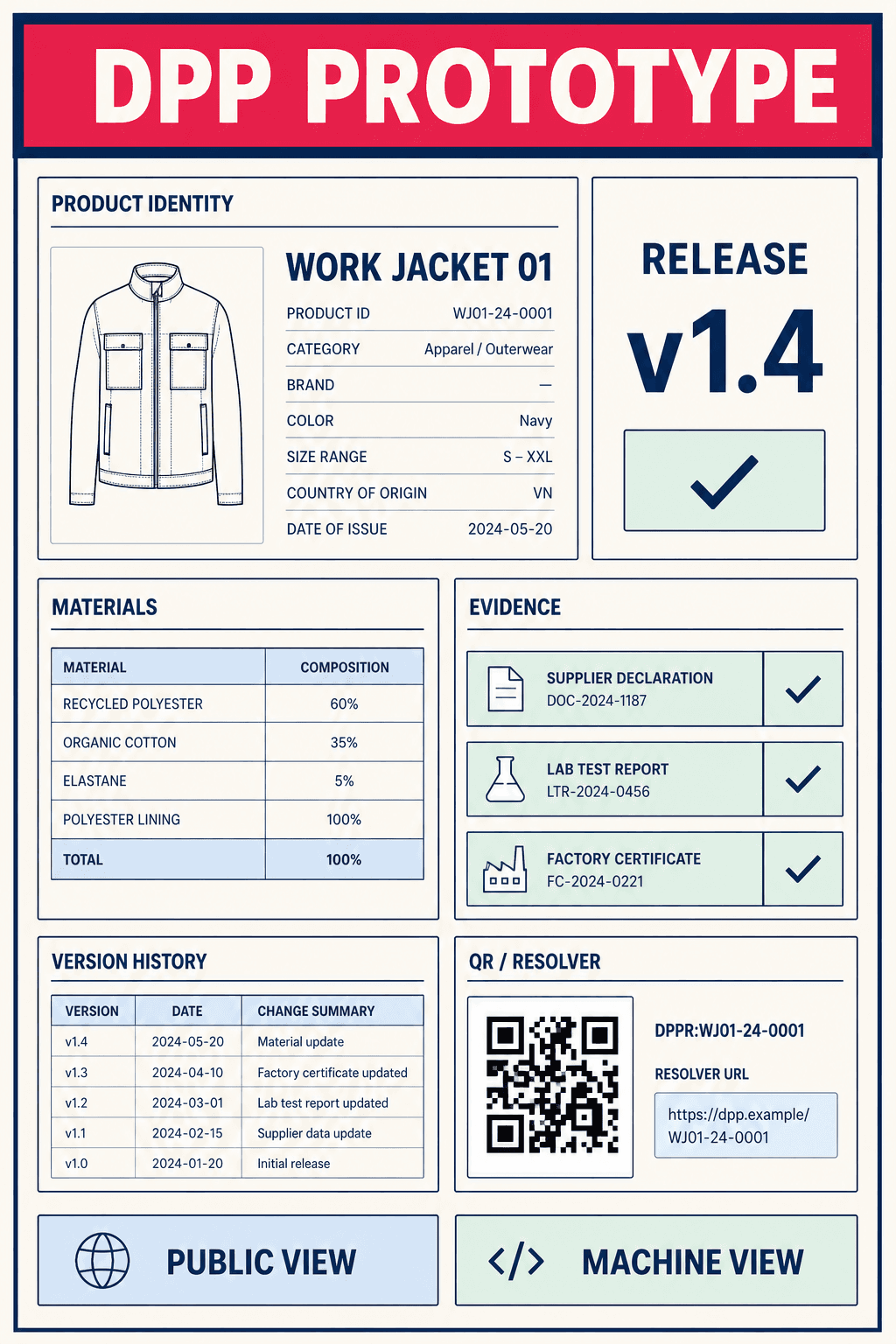
This page explores one part of the Digital Product Passport. For implementation, the DPP data model connects product identity, fields, evidence and access rights.
Reusing EPD and LCA data in a DPP
An EPD can provide credible environmental facts and methodological evidence. The DPP remains a separate data product that connects those values to product identity, the current version, audiences and other product or compliance data. Map selected EPD/LCA values to defined DPP fields and link the declaration itself as evidence instead of embedding only a PDF.
The technical separation is explained in the DPP data model. Return to the Digital Product Passport overview.
No: an EPD does not replace a DPP—and vice versa
According to the International EPD System, an Environmental Product Declaration (EPD) is a verified and registered document that communicates transparent, comparable information about lifecycle environmental impacts. Its purpose is to communicate reviewed life-cycle assessment results.The International EPD System definition is a useful technical reference.
The Digital Product Passport, by contrast, is a digital product-specific information and access structure. Depending on the product group, it can cover safety, origin, materials, repairability, environmental performance, reuse and recycling. The applicable legal act—not a generic DPP template—determines which information is mandatory.The European Commission overview of the DPP describes this framework.
Not an either-or choice
The Digital Product Passport and EPD solve different problems
The comparison helps structure the data architecture. It does not replace a product-specific legal assessment.
EPD
Digital Product Passport
Primary purpose
Verified environmental information from a life-cycle assessment under programme rules.
Product-specific information and access structure across the lifecycle.
Data scope
Environmental impacts and methodology are the central focus.
Can connect environmental, identity, material, repair, safety and conformity data.
How they work together
An EPD document or its digital dataset can provide credible evidence.
Can reference an EPD or reuse suitable values where the legal act and data model require them.
Governance
Verification follows the relevant EPD programme and its rules.
Obligations, content and access rights follow the product-specific EU legal framework.
An EPD can provide evidence in the DPP data flow
A useful connection is not an automatic data transfer. An EPD can act as a source or evidence for selected environmental information in a DPP. The passport may additionally require product identity, access rules, repair information, material data, conformity evidence and information for other lifecycle actors. Which values can be reused depends on product granularity, methodology, validity, the applicable legal act and the data model.
The relationship without overclaiming
This is an implementation conclusion, not a general EU requirement: an EPD can be valuable DPP evidence, but its existence does not make a DPP complete or mean that every product group requires an EPD.
The distinction is particularly practical for construction products: performance and conformity information, environmental information and digital product data follow partly different rules but must be connected in implementation. The European Commission information on declarations of performance and CE marking explain this distinct product-law logic.
Why version dates matter for EPD content
EPD content should not be treated as if terminology and programme rules never change. ISO 14025 was updated in June 2026, and the International EPD System notes that the new edition develops programme terminology and requirements. A DPP data flow should therefore retain the programme, PCR, validity, version and provenance of reused EPD data.The explanation of the ISO 14025:2026 update demonstrates why this maintenance matters.
- Reference the EPD as a source instead of copying values without context.
- Validate the product or variant scope and validity.
- Document the methodology, PCR and verification status.
- Make clear which DPP fields originate from an EPD and which use other evidence.
- Trigger a controlled change and approval process whenever the EPD changes.
To build this data flow, use the DPP example and template for field and evidence structure. The implementation roadmap shows how to turn it into a pilot with clear responsibilities.

Written by
Nils
Nils Abegg is a developer with more than 15 years of experience, including around ten years in e-commerce. Since 2023, he has focused on agentic AI and enjoys building practical AI solutions for small and medium-sized businesses.